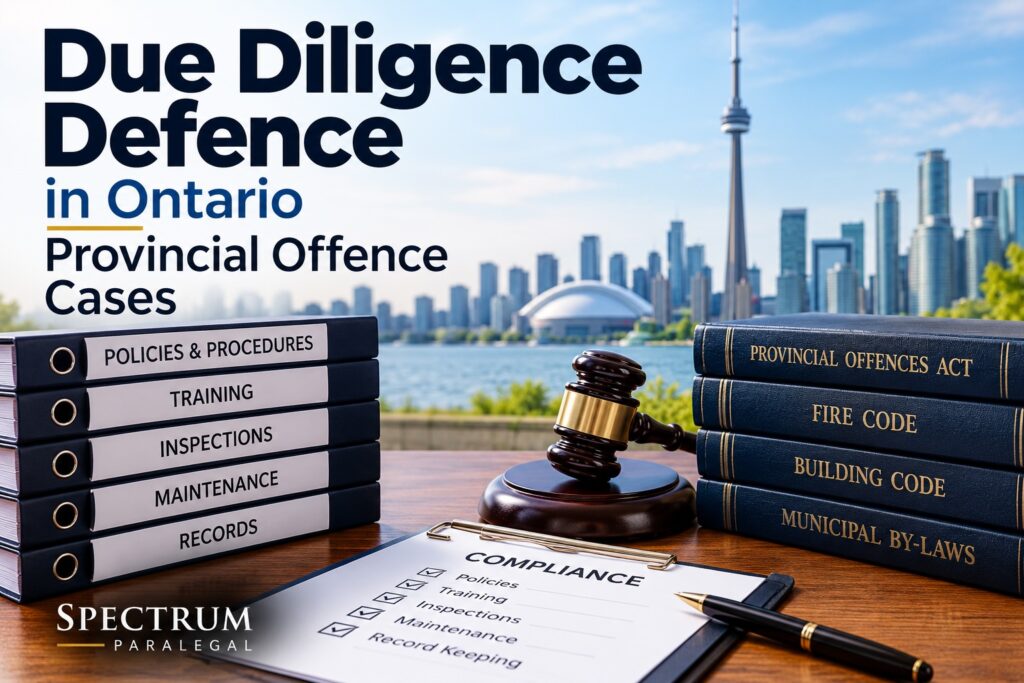


In Ontario, provincial offences under the Fire Code and Building Code, local bylaws and statutes regulating various professional and business activities may be characterized as regulatory offences. A person or business may be charged with such an offence even when there was no intention to break the law.
However, the accusation of committing a regulatory offence does not necessarily lead to a conviction. In certain cases, a defendant may rely on the due diligence defence. The defence can show that it took reasonable steps to prevent the violation.
The due diligence defence can be particularly relevant for businesses. It may also cover property owners, employers, commercial vehicle operators, and other regulated parties facing provincial offence charges in Ontario.
What Is the Due Diligence Defence?
In simple terms, due diligence means taking reasonable steps to prevent an offence.
The Supreme Court of Canada established the approach to regulatory offences in a widely regarded and groundbreaking case, R. v. Sault Ste. Marie. This case states that, in most regulatory offences, the prosecution does not normally have to prove the defendant’s intention or negligence in committing the offence. However, the defendant may avoid conviction by establishing due diligence.
This defence involves showing that the defendant:
- took all reasonable steps to avoid the prohibited event; or
- reasonably believed in facts which, if true, would have made the conduct innocent.
Unlike the prosecution, the defendant must establish due diligence on a balance of probabilities.
Read the Supreme Court of Canada decision discussing the due diligence defence
Strict Liability and Absolute Liability Offences
Due diligence is not available for every provincial offence. An important distinction exists between strict liability and absolute liability offences.
For a strict liability offence, the prosecution must prove the prohibited act or omission, but the defendant can raise a due diligence defence.
For an absolute liability offence, due diligence is not a defence. Once the prosecution proves the elements of the offence, the defendant cannot avoid liability simply by showing that they took reasonable precautions.
Whether an offence is strict or absolute liability depends on the legislation and the particular offence. Therefore, the party must determine the precise statute or regulation before deciding whether it can rely on due diligence.
The Provincial Offences Act sets the procedural framework for Ontario provincial offence proceedings.
“I Didn’t Know” Is Not Enough
A defendant charged with a regulatory offence cannot avoid liability by saying they were unaware of the law. This does not excuse the violation. Lack of knowledge alone is generally not a due diligence defence.
The due diligence defence usually requires an answer to the important question: what the defendant actually did to prevent the violation.
For example, a business may need to show it had an effective compliance system rather than simply stating that management was unaware an employee had failed to follow a requirement.
Similarly, a property owner may need evidence of inspections, maintenance, or repairs rather than simply saying the owner did not know a problem existed.
What Evidence Can Help Establish Due Diligence?
The due diligence defence depends heavily on the circumstances of each case. The evidence should be relevant to the particular alleged violation.
Depending on the case, helpful evidence may include:
- inspection and maintenance records;
- written policies and procedures;
- employee training records;
- instructions given to employees or contractors;
- photographs and videos;
- repair invoices and work orders;
- emails and other correspondence;
- safety or compliance protocol and checklists;
- records of regular supervision; and
- evidence of measures taken when a problem was found.
Documents from the time before the alleged offence can be particularly important. They may demonstrate what systems and precautions were actually in place at the relevant time.
Due Diligence for Businesses and Employers
Businesses frequently rely on employees, managers and contractors to comply with regulatory requirements.
If a violation occurs and authorities lay charges, blaming an employee will not establish a due diligence defence. The business needs to demonstrate that it had a reasonable system designed to prevent the violation and that reasonable steps were taken to make that system work. This can involve appropriate policies, training, supervision, inspections and record keeping.
These considerations can be particularly important for regulated businesses and professionals facing provincial offence charges, where a conviction may have consequences beyond the immediate fine.
Due Diligence for Property Owners and Landlords
Property owners and landlords may also face regulatory charges involving building conditions, municipal requirements or fire safety.
For example, in an Ontario Fire Code charge, evidence of regular inspections, maintenance, repairs and appropriate instructions to contractors or employees may become important when assessing due diligence. The same approach is true for municipal by-law charges in Ontario.
The question is not whether something went wrong but what reasonable precautions were taken before the alleged violation occurred.
What About Correcting the Problem After the Charge?
Correcting a violation is generally a sensible step and may be relevant when discussing a possible resolution with the prosecutor. However, correcting the problem after an inspection or charge does not establish due diligence.
This defence focuses on the reasonable steps taken to prevent the offence before it happened.
Subsequent repairs or improvements may still be useful evidence. They can show cooperation and ongoing compliance and may help negotiations with the prosecution. However, they should not be confused with evidence of precautions in place before the alleged offence.
Due Diligence Depends on the Specific Charge
There is no universal checklist that automatically establishes due diligence. What is reasonable for a small property owner may be different from what is reasonably expected of a large corporation with employees, managers and formal compliance systems.
The precautions must also relate to the specific offence charged. General evidence that a business is normally careful or responsible may not help to defend the particular offence before the court.
For that reason, the charge, applicable legislation and prosecution disclosure should be carefully reviewed before determining whether due diligence provides a realistic defence.
Due Diligence Defence in Provincial Offences Court
Due diligence can be a primary defence to some Ontario regulatory charges, but it depends on both the nature of the offence and the available evidence.
The defence must identify the exact offence and verify due diligence is legally available. They should review the prosecution’s evidence and obtain documents showing what precautions were taken.
Spectrum Paralegal represents individuals and businesses facing regulatory and other provincial offence charges in Toronto and across Ontario.
If you are facing a provincial offence charge, we can review the charge, request the prosecution’s evidence, assess whether a due diligence defence is available, communicate with the prosecutor, and represent you in Provincial Offences Court.