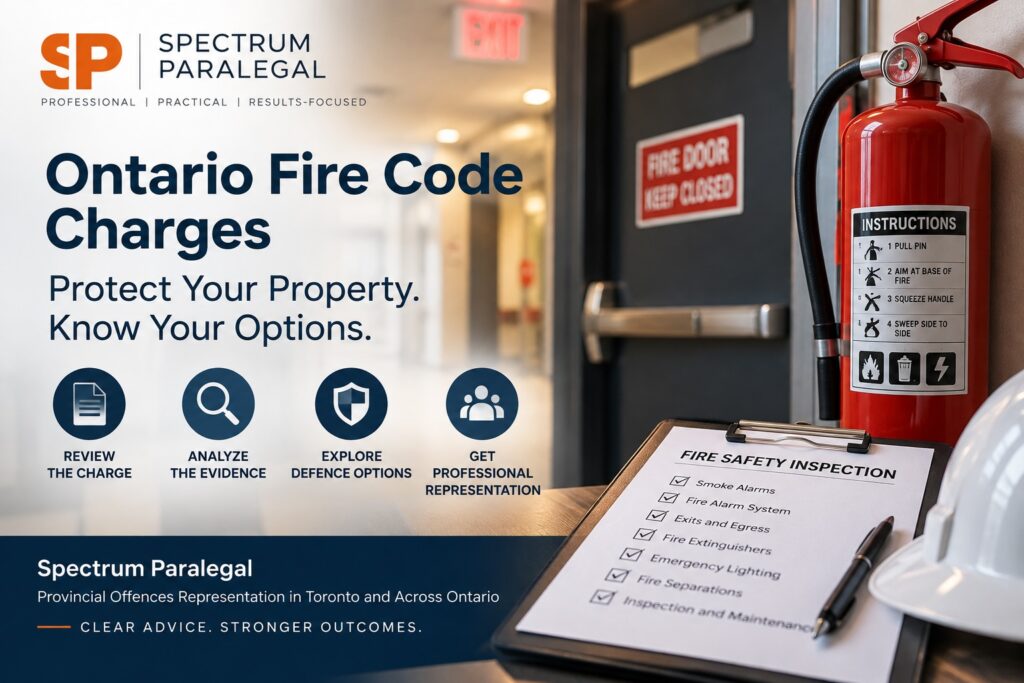


Ontario property owners, landlords and businesses may face charges under the Fire Protection and Prevention Act, 1997 when a fire inspection finds an alleged violation of the Ontario Fire Code.
A Fire Code charge is a provincial offence and can be more serious than it initially appears. These cases may involve significant fines, technical requirements and questions about who was responsible for compliance. These cases may involve very significant fines, technical issues and questions about who is responsible for compliance. As such, it is important to understand the charge, review the prosecution’s evidence and see whether a defence is available.
What Is the Ontario Fire Code?
The Ontario Fire Code is a provincial bylaw establishing fire safety requirements for buildings and houses across the province.
Depending on the property type, these requirements may cover smoke and carbon monoxide alarms, fire alarm systems, fire exits, fire separations and materials, emergency lighting, fire extinguishers, fire safety plans, and the inspection and maintenance of fire protection equipment and systems.
Fire safety requirements can be technical. For this reason, the exact section of the Fire Code cited in the charging document (summons) matters.
How Do Fire Code Charges Arise?
A local fire department inspection usually starts the process. It may be routine, based on a specific complaint, follow a fire or other incident, or done for another enforcement reason.
If an inspector finds a violation, the property owner or another legally responsible person may be required to correct the problem. However, in many cases, an inspector may also lay charges.
Common allegations may involve:
- missing or improperly maintained smoke or carbon monoxide alarms;
- fire alarm systems;
- blocked or inadequate exits;
- fire extinguishers and other safety equipment;
- fire separations and their materials
- inspection and maintenance requirements; and
- failure to comply with an order of the Fire Department
Who Can Be Charged?
Fire Code charges may be laid against, and summons may be issued to, a property owner, landlord, corporation, or other persons responsible for the building.
In many cases, more than one person may be charged in relation to the same property, when, for example, there are co-owners of the property.
For this reason, determining who is legally responsible for the alleged violation can be an important point in a Fire Code case.
What Are the Possible Penalties?
Fire Code offences can carry substantial penalties.
The potential penalty depends on the specific offence and whether the defendant is an individual or a corporation. The legislation provides for significant maximum fines and, for certain offences involving individuals, even imprisonment.
The maximum penalty is not necessarily the one imposed in a particular case. Nevertheless, a Fire Code summons should be taken seriously.
What Evidence May be Available to the Prosecutor?
Before deciding how to proceed and whether it is better to negotiate with the prosecutors or plead not guilty and have a trial, the defence must obtain and review the prosecution’s disclosure of evidence.
Depending on the case, disclosure may include inspection reports, photographs, fire inspector’s notes, previous inspection records, orders, and correspondence with the property owner.
The defence should consider whether the evidence supports the exact Fire Code violation stated in the charge.
Documents the property owner holds may also be relevant. These may include maintenance records, invoices, photographs, inspection records and communications with contractors or property management.
Is Correcting the Problem Enough to Avoid Fire Code charges?
Promptly correcting a Fire Code problem is important, but it does not necessarily erase an existing or future charge.
However, prompt correction may still be relevant when discussing the case with the prosecutor and can be important when the court considers the circumstances of the offence.
The steps taken before the alleged offence date may be even more important when assessing whether a defence is available.
Is a Due Diligence Defence Available in the Fire Code Cases?
Depending on the particular offence, a due diligence defence may be available to the accused.
It is available for an accused to show that steps were taken to prevent the Fir Code violation. Evidence of regular inspections, maintenance, repairs, instructions to contractors or employees, and systems designed to ensure Fire Code compliance may therefore be important.
Simply saying that the owner did not know about the problem is never sufficient.
We will discuss the due diligence defence in Ontario provincial offence cases in a separate article in this series.
Can a Fire Code Charge Be Resolved Without a Trial?
Some Fire Code cases can be resolved and ended through negotiations with the prosecutor.
Depending on the circumstances, a resolution could involve withdrawal or reduction of charges, or an agreement concerning the penalty. Correcting the violation and demonstrating ongoing compliance with the Fire Code requirements may also be relevant to the resolution.
Review the substance of the charge and the evidence before negotiating a resolution and deciding whether a trial is the better approach.
Ontario Fire Code Defence
Fire Code cases can involve much more than the outcome of a fire inspection. Relevant Fire Code requirements, available evidence, property ownership, and the steps taken to prevent the alleged violation may all matter.
Spectrum Paralegal represents property owners, landlords, individuals and businesses facing Ontario Fire Code and other provincial offence charges in Toronto and across Ontario.
If you have received a Fire Code summons, we can review the charge and disclosure, assess possible defences, communicate with the prosecutor and represent you in Provincial Offences Court.