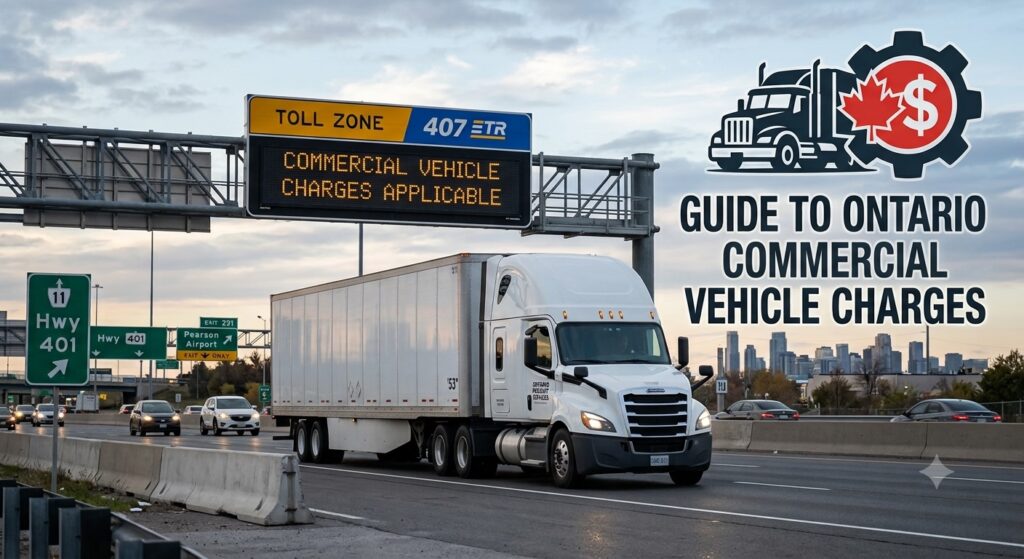



Commercial drivers and trucking companies operating in Ontario are subject to a complex regulatory framework. Unlike ordinary traffic offences, commercial vehicle charges may have consequences extending beyond the immediate fine, including effects on a carrier’s Commercial Vehicle Operator’s Registration (CVOR) record, safety rating, insurance costs, and business operations.
Understanding the most common commercial vehicle charges may help drivers, owner-operators, and carriers reduce compliance risks and make informed decisions when responding to enforcement action.
Commercial Vehicle Enforcement in Ontario
Commercial vehicle enforcement in Ontario is carried out primarily by police officers and enforcement officers appointed by the Ministry of Transportation. Depending on the circumstances, charges may be laid under the:
- Highway Traffic Act
- Dangerous Goods Transportation Act
- Commercial Vehicle Drivers Hours of Service Regulations
- Compulsory Automobile Insurance Act
- other transportation-related legislation
Commercial vehicle charges are prosecuted within Ontario’s broader Provincial Offences system. Spectrum Paralegal also provides representation in other Provincial Offences matters, including traffic charges, municipal by-law offences, Fire Code and Building Code charges, and other regulatory matters.
Some offences are directed primarily at commercial drivers, while others are the responsibility of the carrier or commercial vehicle operator. In some situations, both the driver and the carrier may be charged arising from the same incident.
1. Daily Vehicle Inspection Violations
One of the most common commercial vehicle charges relates to daily inspections.
Examples include:
- failing to conduct a required inspection
- failing to carry an inspection report
- incomplete inspection reports
- inaccurate inspection records
Daily inspection requirements are an important part of commercial vehicle safety compliance and are frequently reviewed during roadside inspections.
2. Major and Minor Defects
Commercial vehicles must not be operated when certain defects exist.
Examples may involve:
- braking systems
- steering components
- tires and wheels
- suspension
- lighting systems
- coupling devices
The classification of a defect as major or minor may significantly affect the legal consequences.
3. Hours of Service Violations
Commercial drivers must comply with Ontario’s Hours of Service rules.
Common charges include:
- exceeding driving limits
- exceeding on-duty limits
- failing to maintain required records
- failing to certify electronic logs
- operating without required electronic logging device (ELD) records
These offences may affect both drivers and carriers.
4. Vehicle Maintenance and Performance Standards
Commercial carriers have legal obligations to ensure their vehicles comply with applicable maintenance and performance standards.
Charges may relate to:
- improper maintenance
- failure to meet prescribed standards
- operating unsafe commercial vehicles
5. Load Securement Violations
Improperly secured cargo may create serious safety risks.
Common allegations include:
- unsecured loads
- shifting cargo
- inadequate securement devices
- failure to comply with applicable securement requirements
6. Dangerous Goods Transportation Offences
Transporting dangerous goods involves additional legal responsibilities.
Common issues include:
- incorrect placarding
- documentation deficiencies
- packaging requirements
- quantity restrictions
- safety equipment requirements
Because dangerous goods legislation is highly technical, these matters often require careful review.
7. Commercial Vehicle Identification Requirements
Commercial vehicles are generally required to display identifying information.
Charges may involve:
- failing to display the operator’s name
- improper lettering
- identification not meeting regulatory requirements
Although these offences may appear minor, they may still affect a carrier’s regulatory compliance record.
8. Weight and Dimension Violations
Ontario regulates both vehicle weights and dimensions.
Charges may involve:
- overweight vehicles
- axle weight violations
- oversized loads
- permit violations
These matters often involve both operational and regulatory considerations.
Why the Type of Charge Matters
Commercial transportation matters should be carefully and broadly evaluated.
Different offences may carry different consequences for:
- CVOR records
- carrier safety ratings
- insurance
- business operations
- regulatory compliance
The nature of the conviction may therefore be just as important as the amount of the penalty.
Before Paying a Commercial Vehicle Ticket
Paying a commercial vehicle ticket generally constitutes a guilty plea.
Before doing so, drivers and carriers may wish to consider:
- possible CVOR consequences
- safety rating implications
- insurance considerations
- available resolution options
- whether a different resolution may be more appropriate
Every commercial transportation matter should be evaluated based on its own facts.
Learn More About Commercial Transportation Law
If you would like to explore these topics in greater detail, you may also be interested in the following articles:
- Commercial Vehicle Charges and CVOR Consequences
- What Are CVOR Points? Common Misconceptions Explained
- Driver Convictions vs. Carrier Convictions: What’s the Difference?
- Can a Reduced Charge Protect Your CVOR Record?
Together, these articles explain how Ontario’s commercial transportation enforcement system works, including CVOR records, safety ratings, driver and carrier liability, and plea resolution considerations.
Conclusion
Commercial transportation law extends well beyond ordinary traffic tickets.
Commercial vehicle charges may have important legal and business consequences for drivers, owner-operators, and trucking companies. Understanding the most common offences and their potential implications can help commercial vehicle operators make informed decisions and better protect their compliance record and business interests.
Need Assistance With a Commercial Vehicle Charge?
Spectrum Paralegal represents drivers, owner-operators, and commercial carriers throughout Ontario in matters involving commercial vehicle offences, transportation law, and Provincial Offences.
If you have received a commercial vehicle charge and are concerned about possible consequences for yourself or your business, contact Spectrum Paralegal to discuss your situation and available options.