

Receiving a provincial offence ticket or summons is a stressful business. This is why you may want to resolve the matter fast, avoid attending court and put the problem behind you.
However, taking a quick guilty plea to a provincial offence is not always the best option, even when the defendant believes that a violation may have occurred.
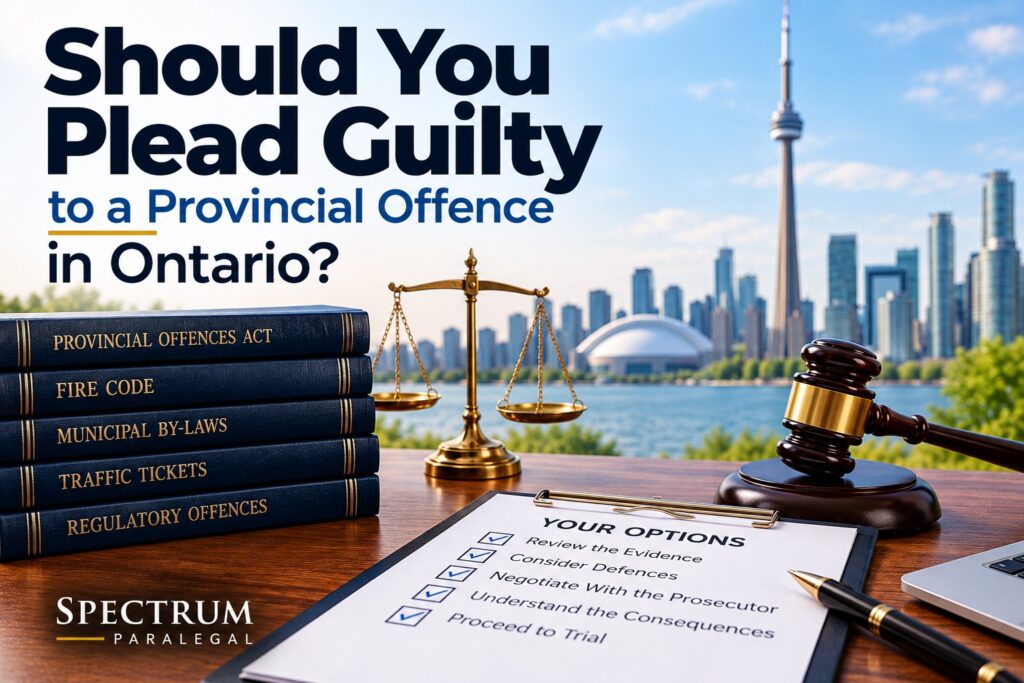
Before doing that, it would make sense to take some time, understand the charge, review the prosecution’s evidence, consider possible defences and assess the consequences of a conviction.
It is true for all provincial offences in Ontario, including traffic tickets, commercial vehicle offences, municipal by-law violations, Fire Code charges and other regulatory offences.
What Happens When You Plead Guilty?
A guilty plea means admitting the offence and accepting a conviction. A conviction results in a fine, court costs and other penalties, depending on the offence.
For traffic tickets, paying the amount shown on the ticket is the same as a guilty plea. Other provincial offence charges require a court appearance.
In some cases, however, the consequences can get beyond the fine. For example, a conviction may affect a driver’s record, a commercial carrier’s CVOR record, auto insurance rate, or the licensing and registration of a regulated business or professional.
Therefore, the amount of the fine should not be the only factor to consider when pleading guilty.
Should You Review the Evidence Before Pleading Guilty?
The short answer is yes.
The prosecution must establish the elements of the offence. Before deciding what to do, the defendant should understand what the charge is and what evidence supports it.
This evidence is commonly called disclosure. Depending on the case, it may include:
- investigating officers’ or inspectors’ notes;
- photographs and video recordings;
- witness statements;
- inspection reports;
- relevant business or maintenance records; and
- other documents relating to the alleged violation.
Reviewing disclosure may reveal weaknesses in the prosecution’s case, missing evidence, questions about the applicable legal requirements or possible defences. Even where the evidence appears strong, reviewing it can help determine whether a proposed resolution is appropriate.
Are There Defences to Provincial Offence Charges?
Yes. The availability of a defence depends on the legislation, the particular charge and the circumstances.
In some cases, the prosecution may be unable to establish an essential element of the offence. In others, the defendant may have evidence supporting a legally recognized defence. For example, certain regulatory offences may be subject to a due diligence defence. A defendant may avoid conviction by establishing that reasonable precautions were taken to prevent the offence. Available defences may also involve questions of identification, responsibility for the alleged conduct, the reliability of the evidence or the interpretation of the applicable legislation.
Of course, the existence of a possible defence does not guarantee an acquittal. However, it is an important consideration before deciding whether to plead guilty or negotiate a resolution.
Can You Negotiate With the Prosecutor?
Many provincial offence cases can be resolved through discussions with the prosecutor without proceeding to trial.
Depending on the evidence, the legislation and the prosecutor’s position, a resolution may involve:
- withdrawal of one or more charges;
- amendment to a less serious offence;
- joint submission for a reduced fine;
- additional time to pay a fine; or
- another appropriate resolution permitted by law.
At the same time, negotiations should be based on a realistic assessment of the case. A defendant who can identify genuine weaknesses in the prosecution’s evidence and a plausible legal defence may have a stronger position when discussing a resolution.
However, even where a defence is unlikely to succeed, mitigating circumstances, corrective action, and cooperation may sometimes assist in negotiating with the prosecution.
It must be noted that a negotiated resolution is not automatically the same as a withdrawal or an acquittal.
Is a Reduced Fine Always a Good Resolution?
Not necessarily. A reduced fine may be an attractive outcome, particularly where the evidence is strong, and the defendant wishes to avoid the expense and uncertainty of a trial.
However, a conviction for a particular offence may have consequences that are more significant than the amount payable. For example, commercial vehicle operators should consider the possible impact on their CVOR records. Drivers may need to consider demerit points, insurance implications or licence-related consequences.
Similarly, regulated businesses and professionals may need to consider whether a conviction could affect licensing, registration, disciplinary proceedings or future business operations.
The important question is not simply how much the fine is, but what the defendant is agreeing to be convicted of and what consequences may follow.
What If the Prosecutor Offers a Guilty Plea Agreement?
Before accepting the offer, the defendant should understand the exact offence, the proposed penalty and any additional consequences. It is also important to remember that the court is not automatically bound by an agreement between the defendant and the prosecutor concerning the penalty. Also, the justice of the peace must be satisfied that the guilty plea is voluntary and informed, and the court retains responsibility for determining the appropriate sentence.
For more information about the procedure, see the Ontario Court of Justice Guide for Defendants in Provincial Offences Cases.
When Does It Make Sense to Proceed to Trial?
A trial may be appropriate when there is a genuine dispute about the alleged offence, the prosecution’s evidence is insufficient, a legally sound defence is available, or the proposed resolution is unacceptable.
However, proceeding to trial involves preparation, possible witnesses, additional expense and uncertainty. As such, the likelihood of success and the potential consequences of a conviction should be taken into account.
In some cases, accepting a reasonable negotiated resolution may be preferable to the risks and costs of trial. In others, disputing charges at trial may be justified. Of course, there is no single answer that applies to every provincial offence case.
What Should You Do After Receiving a Provincial Offence Ticket or Summons?
The first step is to identify the exact charge and determine the applicable court procedure.
For many offence notices, such as traffic tickets, a defendant must respond within 15 days. The available options may include paying the fine, requesting an early resolution meeting or requesting a trial, depending on the type of ticket and court procedure. A summons generally requires attendance at the specified court appearance.
Ignoring a ticket or summons can have serious consequences, including a conviction without the defendant participating in a hearing. The Ontario government’s guide to traffic tickets and provincial offence procedures provides further information about available options.
Provincial Offence Defence and Representation in Ontario
Deciding whether to plead guilty, negotiate a resolution or proceed to trial should involve more than simply comparing the amount of the fine with the cost of representation. A proper approach is to consider the legal elements of the charge, the prosecution’s evidence, possible defences, the likelihood of conviction and the broader consequences of a guilty plea.
Spectrum Paralegal represents individuals and businesses facing provincial offence charges in Toronto and across Ontario. Our services include requesting and reviewing disclosure, assessing possible defences, communicating and negotiating with prosecutors, attending court and representing clients at trial when necessary.