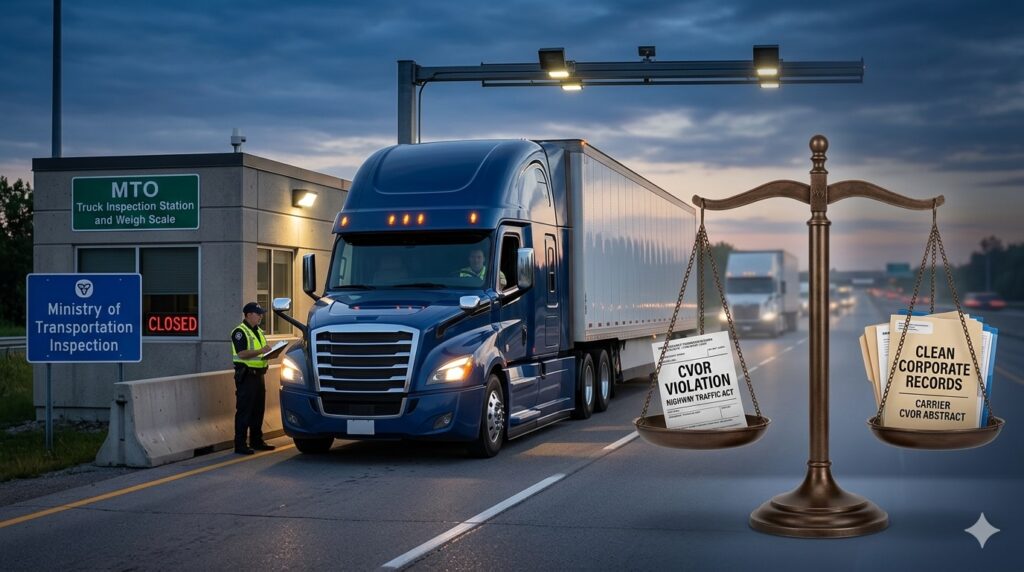



For many commercial drivers and transportation companies (carriers) in Ontario, receiving a traffic or commercial vehicle charge raises an immediate concern: will this affect the Commercial Vehicle Operator’s Registration (CVOR) record?
The answer is often yes. Depending on the nature of the charge and who is convicted, a conviction may affect the carrier’s CVOR record and the carrier’s safety rating. Understanding the relationship between charges, convictions, and CVOR consequences is important for both drivers and commercial vehicle operators.
What Is a CVOR?
The Commercial Vehicle Operator’s Registration (CVOR) system is used by the Ministry of Transportation of the Province of Ontario to monitor the safety performance of commercial vehicle operators.
The system tracks information such as:
- convictions
- collisions
- inspections
- out-of-service defects
- administrative sanctions
The Ministry of Transportation uses this information to assess a carrier’s safety performance and identify operators that may require intervention.
Who Can Be Affected by a Charge?
Many people assume that only the driver is affected when a commercial vehicle charge is issued. In reality, the consequences extend beyond the driver.
Depending on the circumstances, charges may be laid against:
- the driver
- the vehicle owner
- the carrier
- multiple parties simultaneously
Does Every Ticket Affect the CVOR?
A traffic ticket may have significant consequences for a company’s CVOR record after a court conviction.
However, the specific impact depends on factors such as:
- the offence involved
- who is convicted
- the legislation under which the charge is laid
- the carrier’s existing safety record
Some convictions may carry significantly greater consequences than others.
Driver Convictions and Carrier Convictions
One of the most misunderstood aspects of the CVOR system is the difference between driver convictions and carrier convictions.
A driver may receive a conviction for an offence committed while operating a commercial vehicle. In many situations, that conviction also affects the company’s CVOR record.
In other situations, the company may be charged directly for failing to comply with legal obligations imposed on commercial vehicle operators.
Because the consequences vary depending on the offence and circumstances, commercial drivers and carriers should carefully assess the potential impact of any ticket.
Why Reduced Charges May Matter
The long-term consequences of a court conviction may be far more significant than the immediate financial penalty.
A resolution involving a different, lower offence may reduce the impact on the carrier’s CVOR record. Whether such a resolution is appropriate depends on the specific charge and facts of the case.
How CVOR Issues Affect Businesses
For commercial truck companies, CVOR consequences may extend well beyond a single conviction.
A poor safety record may affect:
- business operations
- contracts and commercial opportunities
- insurance costs
- regulatory scrutiny by MTO
- overall safety ratings
As a result, a commercial transportation company should evaluate charges not only from the driver’s perspective but also from the broader business perspective: consider the CVOR record and number of safety points involved.
Common Commercial Vehicle Charges
Commercial vehicle operators may face charges relating to:
- daily vehicle inspections
- vehicle defects
- maintenance requirements
- load securement
- hours of service
- dangerous goods transportation
- weight and dimension requirements
- performance standards
Each category of offence may carry different consequences and should be evaluated individually.
Why Legal Advice May Be Important
Commercial transportation legislation is often more complex than ordinary traffic law.
A charge that appears minor may have significant implications for a driver, a carrier, or both.
Before pleading guilty or resolving a commercial vehicle matter, operators may wish to understand:
- the potential effect on the CVOR record
- the impact on safety ratings
- available resolution and trial options
- possible alternatives to the original charge
Obtaining legal advice early may help commercial vehicle operators make informed decisions.
Conclusion
A commercial vehicle charge can affect a truck company’s CVOR record, but the consequences depend on the specific offence, who is convicted, and the carrier’s overall safety history.
Understanding the distinction between driver liability and carrier liability is essential. While dealing with commercial vehicle charges, drivers and carriers should carefully consider not only the immediate fine but also the potential long-term impact on their operations and compliance record.
Need Assistance With a Commercial Vehicle Matter?
Spectrum Paralegal represents drivers, owner-operators, and commercial carriers in Ontario facing traffic, transportation, and regulatory charges.
If you have received a commercial vehicle charge and are concerned about potential CVOR consequences, contact Spectrum Paralegal to discuss your situation and available options.