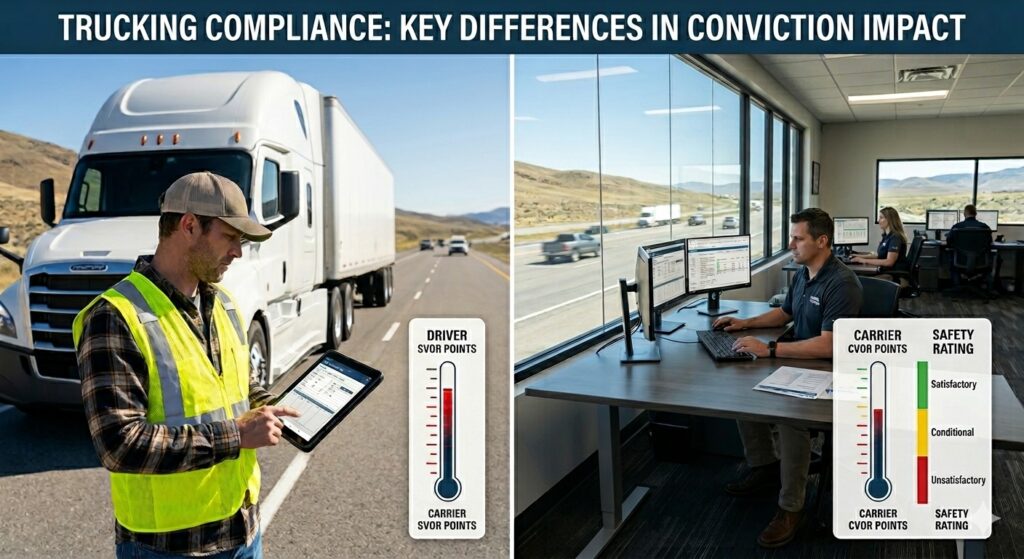



Commercial drivers and trucking companies should know that a ticket issued to a driver may affect the carrier, and a ticket issued directly to the carrier may have significant consequences even if the driver is not charged.
Understanding this fact is important because it affects a company’s CVOR record, safety rating, insurance costs, and business operations.
As such, before deciding how to respond to a commercial vehicle charge, both drivers and carriers should understand who may ultimately be affected by a conviction.
Drivers and Carriers Have Different Legal Responsibilities
Ontario’s commercial transportation laws impose obligations on both drivers and carriers.
Drivers are responsible for complying with many requirements while operating a commercial vehicle, including:
- conducting required vehicle inspections
- operating a vehicle safely
- complying with hours-of-service requirements and keeping a record of the work hours
- reporting defects when required
- complying with general traffic laws
Carriers and commercial vehicle operators have their own responsibilities, which may include:
- maintaining vehicles
- ensuring regulatory compliance
- keeping required records
- monitoring driver qualifications
- implementing safety policies
As a result, the same incident may sometimes create potential liability for both the driver and the carrier.
What Is a Driver Conviction?
An enforcement officer of the Ministry of Transportation or a police constable may issue a ticket to a commercial driver. A conviction occurs when a commercial driver is convicted by the court of an offence committed while operating a commercial vehicle.
Examples of the tickets given to a commercial driver may include:
- operating a vehicle with a defect
- hours-of-service violations
- improper inspections
- load securement violations
- committing a general traffic offence such as speeding or red light
Although the conviction is registered against the driver, it may also have consequences beyond the driver’s personal record.
In almost all situations, the conviction may affect the carrier’s CVOR record and safety rating.
What Is a Carrier Conviction?
A carrier conviction occurs when the commercial vehicle operator or transportation company is charged and convicted of an offence for which the company is legally responsible.
Examples may include:
- failing to maintain required records
- permitting a vehicle to operate in a non-compliant condition
- failing to ensure compliance with regulatory requirements
- permitting a driver to operate contrary to legal obligations
Carrier convictions may directly affect the carrier’s CVOR record and overall safety performance profile.
Can the Same Incident Affect Both the Driver and the Carrier?
Yes.
The commercial vehicle traffic stop may result in:
- charges against the driver only
- charges against the carrier only
- charges against both the driver and the carrier
One of the most common misconceptions is that only a party to whom a ticket was issued can be affected by a commercial vehicle offence. However, this is not so in all cases.
For this reason, carriers should not assume that a driver’s ticket is solely the driver’s problem, and drivers should not assume that a carrier’s compliance issue cannot affect them.
Potential Consequences of Convictions
For Drivers
- fines
- demerit points (where applicable)
- employment consequences
- impacts on professional driving opportunities
For Carriers
- CVOR points
- safety rating implications
- increased regulatory scrutiny
- insurance consequences
- impacts on commercial relationships
As a result, a conviction that appears relatively minor at first glance may have broader consequences for both a commercial driver and the transportation company.
How Convictions May Affect a CVOR Record
A transportation company’s CVOR record is intended to reflect the safety performance of the commercial vehicle operation.
Most driver convictions may affect the carrier’s CVOR record even though the conviction is technically registered against the driver.
Similarly, carrier convictions may affect the carrier’s safety profile regardless of whether the driver receives a charge.
To better understand how this system works, you may also wish to read our articles:
- Commercial Vehicle Charges and CVOR Consequences
- What Are CVOR Points? Common Misconceptions Explained
Why Legal Advice May Be Important
Commercial transportation matters often involve more than simply determining who received the ticket.
Drivers and carriers may wish to understand:
- who may be affected by a conviction
- potential CVOR consequences
- safety rating implications
- available resolution options
- possible alternatives to the original charge
Obtaining legal advice before resolving a commercial vehicle charge may help both drivers and carriers make informed decisions.
Conclusion
The distinction between driver convictions and carrier convictions is an important aspect of Ontario’s commercial transportation system.
A conviction issued to a driver may affect a carrier’s CVOR record, while a conviction issued directly to a carrier may have significant business and regulatory consequences.
Understanding these differences can help drivers, owner-operators, and trucking companies better assess the risks associated with commercial vehicle charges and make informed decisions about how to proceed.
Need Assistance With a Commercial Vehicle Matter?
Spectrum Paralegal represents drivers, owner-operators, and commercial carriers in Ontario facing commercial vehicle, transportation, and Provincial Offences charges.
If you have received a commercial vehicle charge and are concerned about potential consequences for yourself, your carrier, or your business, contact Spectrum Paralegal to discuss your situation and available options.