


Many commercial drivers and carriers have heard the term “CVOR points” or “safety points,” but do not fully understand what it actually means.
Misunderstanding the CVOR system can lead drivers and commercial vehicle operators to make important decisions without fully appreciating the consequences. In some cases, people overlook the potential impact on a carrier’s safety record.
Understanding how the Commercial Vehicle Operator’s Registration (CVOR) system works can help drivers and trucking companies make better-informed decisions when dealing with commercial vehicle charges.
What Is the CVOR System?
The Commercial Vehicle Operator’s Registration (CVOR) system is used by the Province of Ontario to monitor the safety performance of commercial vehicle operators.
The Ministry of Transportation collects information relating to:
- convictions
- collisions
- inspections
- out-of-service defects
- administrative sanctions
This information is used to assess a carrier’s safety performance and determine whether intervention may be necessary.
If you are unfamiliar with the basics of the CVOR system, you may also wish to read our article: Commercial Vehicle Charges and CVOR Consequences.
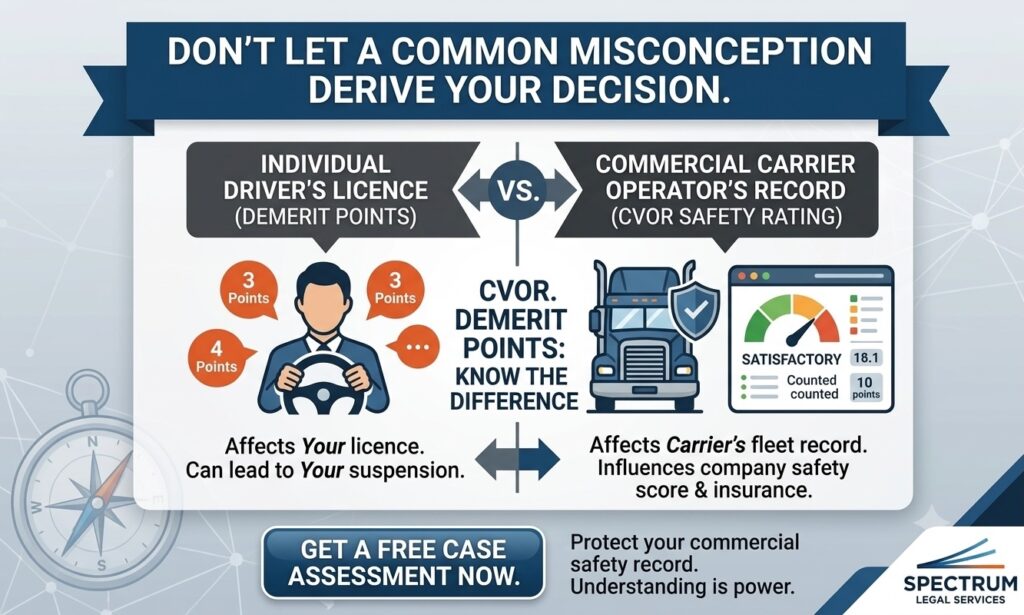
Misconception #1: CVOR Points and Demerit Points Are the Same Thing
This is probably the most common misunderstanding.
Demerit points are associated with an individual’s driver’s licence.
CVOR consequences relate to the safety performance of commercial vehicle operators and carriers.
While a single incident may affect both a driver’s record and a carrier’s record, the two systems are distinct and serve different purposes.
Misconception #2: Every Commercial Vehicle Ticket Creates CVOR Points
Not every charge results in the same consequences.
The impact depends on factors such as:
- the offence involved
- who is convicted
- the applicable legislation
- the carrier’s existing safety history
Some convictions may have a greater effect on a carrier’s safety profile than others.
For example, a conviction for failing to display a commercial vehicle operator’s name on a vehicle may result in 0 CVOR points, while operating a commercial vehicle with a major defect may result in 3 CVOR points. As a result, the seriousness of a charge for CVOR purposes is not always reflected by the amount of the fine or by whether the charge is issued to the driver or directly to the carrier.
Misconception #3: Only Carriers Need to Worry About CVOR Issues
Drivers often assume that the consequences of CVOR are solely the carrier’s problem.
In reality, the interests of drivers and carriers are frequently connected.
A conviction may affect:
- employment opportunities
- relationships with carriers
- internal company policies
- future business opportunities
For this reason, both drivers and carriers should understand the potential consequences of commercial vehicle charges.
Misconception #4: The Fine Is the Most Important Issue
In commercial transportation matters, the long-term consequences of a conviction may be more significant than the immediate financial penalty.
Potential concerns may include:
- safety performance records
- insurance implications
- regulatory scrutiny
- commercial relationships
- future compliance issues
When deciding how to deal with a ticket issued to a commercial driver or a trucking company, it is often advisable to consider all potential consequences, not just the fine.
Misconception #5: A Reduced Charge Never Matters
Some people believe that if they are going to pay a fine anyway, there is little value in seeking a reduction or alternative resolution.
This is not always true.
Depending on the circumstances, different charges may carry different regulatory and compliance consequences.
In some situations, a conviction for an offence carrying a higher fine may have less impact on a carrier’s CVOR record or safety rating than a conviction for a different offence carrying a lower fine. For that reason, the nature of the conviction may be as important as the amount of the penalty.
Why Carriers Monitor CVOR Performance
Commercial carriers operate in a highly regulated environment.
Maintaining a positive safety record may help carriers:
- reduce regulatory attention
- maintain business relationships
- manage insurance costs
- demonstrate compliance
For this reason, many trucking companies monitor commercial vehicle charges closely and assess their potential impact before deciding how to proceed. Learn more about how a commercial vehicle ticket can affect your CVOR record.
Why Legal Advice May Be Important
Commercial transportation law involves more than simply paying or disputing a ticket.
Drivers and carriers may wish to understand:
- potential CVOR consequences
- safety rating implications
- fleet insurance implications
- available resolution options
- the distinction between driver and carrier liability
Obtaining legal advice early may help commercial vehicle operators make informed decisions.
Conclusion
Despite the common use of the term “CVOR points,” the CVOR system is considerably more complex than a traditional demerit point system. Numerous offences under transportation and highway safety legislation may affect a carrier’s CVOR record and safety rating.
Drivers and carriers should understand that convictions may have consequences that extend beyond fines, and that the impact of a commercial vehicle charge depends on many factors, including the nature of the offence and the circumstances of the case.
Understanding these issues can help commercial vehicle operators better protect their compliance record and business interests.
Need Assistance With a Commercial Vehicle Charge?
Spectrum Paralegal represents drivers, owner-operators, and commercial carriers in Ontario facing commercial vehicle, transportation, and Provincial Offences charges. Learn more about the experience of Spectrum Paralegal’s founder.
If you are concerned about how a commercial vehicle charge may affect your CVOR record or business operations, contact Spectrum Paralegal to discuss your situation and available options.